
Table of Contents
Choosing the right moving box sizes can save you from one of the most common moving-day problems: damaged items, injured movers, and wasted time loading the moving truck.
Whether you’re planning a local move in Ottawa or heading farther across Ontario, choosing the right boxes is one of the most practical decisions you’ll make before the truck arrives and will make your move faster, safer, and far less stressful.
Since 1908, Cassidy’s has helped Ottawa and Ottawa Valley families pack, load, store, and move their belongings safely. With well over a century of moving experience, we’ve seen firsthand how much the right box matters.
Free Ultimate Moving Checklist
Say goodbye to moving stress with our 2025 residential moving checklist for Canada—it’s the ultimate time-saver!
Download NowThis guide covers every standard moving box size, what belongs in each one, and how many boxes you’re likely to need for your home.
The Standard Moving Box Sizes
Any box can average 40-50 lbs max. However, a professionally packed china carton could be as much as 60-70 lbs.
Always use a crumpled-up newsprint to create a good cushion on the bottom and top to ensure no movement inside the box.
When packing weights, packing in a ½ 2cuft will ensure they can be lifted with reasonable effort. You can easily wrap weights in paper, stack flat ½ way up the box. Then cut the corners down to fit, then simply fold in and tape all around.
Before we get into the specific box sizes below, a quick note on the naming.
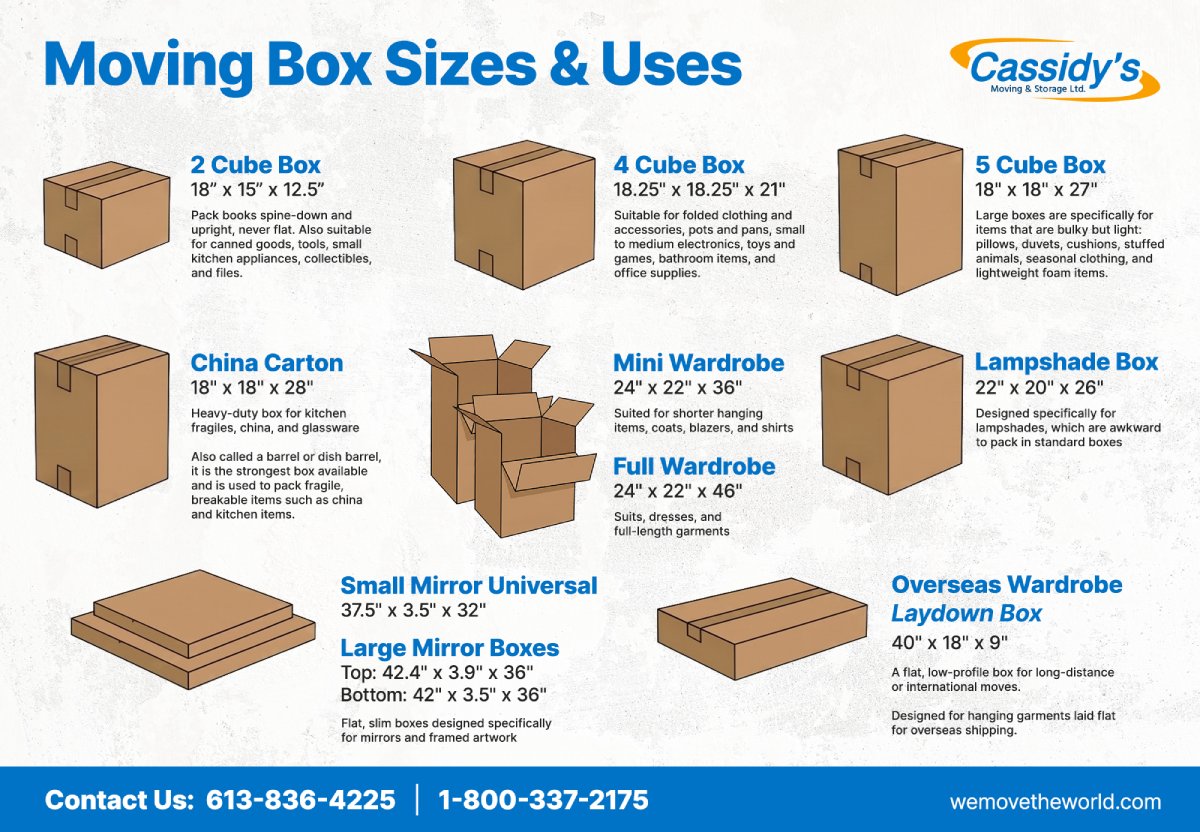
The number before “cube” refers to the approximate cubic feet of space inside the box. A 2-cube box holds roughly 2 cubic feet, a 4-cube about 4, and a 5-cube about 5.
Measurements are rounded rather than exact, but the naming system makes it easier to choose the right box size at a glance. Specialty boxes (covered in the next section) are usually named for the items they are designed to carry instead.
2 Cube Box (18″ × 15″ × 12.5″)
The small box is your workhorse for dense, heavy items. Common examples include canned goods, tools, small kitchen appliances, collectibles, and files.
Pack books spine-down or flat, especially large or heavy books, such as art books. This helps reduce stress on the binding and protects the joints during transport.
If the box feels too heavy to lift comfortably with two hands, remove a few items and start another box.
4 Cube Box (18.25″ × 18.25″ × 21″)
The medium box handles most of what a home produces: folded clothing and accessories, pots and pans, small to medium electronics, toys and games, bathroom items, and office supplies. It’s versatile enough for almost every room.
For more on packing clothing efficiently, our post on how to pack clothes for moving covers folding, rolling, and layering techniques.
5 Cube Box (18″ × 18″ × 27″)
Large boxes are not for heavy items. They’re specifically for bulky yet lightweight items: pillows, duvets, cushions, stuffed animals, seasonal clothing, and lightweight foam items. If you fill one of these with books, it won’t make it off the floor.
Quick Note on Box Weight
As a general rule, if you have to strain to lift it, the box is too heavy. Exact weight limits can vary by box type and material, so ask us for specific recommendations when you order supplies.
Specialty Moving Boxes (When You Need More Than Standard)
Standard sizes handle most of a home, but certain items need a box built specifically for the job.
China Carton (18″ × 18″ × 28″)
Also called a dish barrel or barrel box, the china carton is one of the strongest moving boxes available.
It’s a heavy-duty option built specifically for fragile kitchen items: china, glassware, ceramics, and anything that won’t survive a standard box collapsing under the weight of a stack.
For details on how to pack these items properly, see our guide to packing dishes and glasses.
Mini Wardrobe (24″ × 22″ × 36″) and Full Wardrobe (24″ × 22″ × 46″)
Wardrobe boxes include a hanging rail so clothes transfer directly from your closet to the box without folding.
The mini wardrobe suits shorter hanging items, such as coats, blazers, and shirts. The full wardrobe handles suits, dresses, and full-length garments. Using these reduces folding and makes unpacking your closet much easier.
Lampshade Box (22″ × 20″ × 26″)
Lampshades are one of the most awkward items to pack in a standard box. They don’t stack, they dent easily, and they don’t sit cleanly in any square container.
The lampshade box is designed specifically for this shape, keeping the shade protected without crushing it.
Mirror Boxes: Small Universal (37.5″ × 3.5″ × 32″) and Large (42.4″ × 3.9″ × 36″ / 42″ × 3.5″ × 36″)
Flat, slim, and reinforced, mirror boxes are designed for mirrors and framed artwork. The large mirror box comes in two telescoping pieces to accommodate different sizes.
Our post on how to pack artwork for moving covers wrapping and padding techniques in detail.
Overseas Wardrobe / Laydown Box (40″ × 18″ × 9″)
A flat, low-profile box designed for long-distance and international moves. Rather than hanging, garments lie flat for overseas shipping, keeping them wrinkle-resistant and container-friendly.
If you’re planning an international or interprovincial relocation, Cassidy’s long-distance and international moving services include guidance on packing requirements for your destination.
Why Moving Box Size Actually Matters
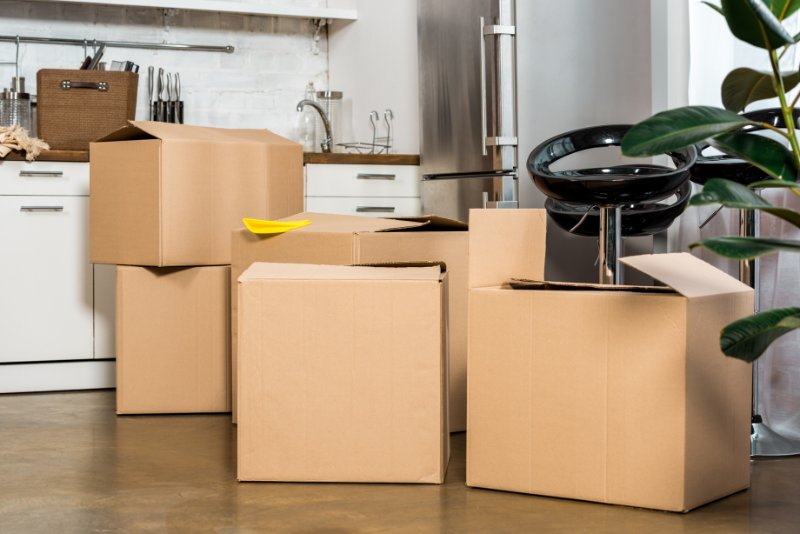
Box size affects more than just the odds of a broken plate.
It shapes how long your move takes, how safe it is for the people doing the heavy lifting, and how much you’ll pay when billing is hourly.
Move Time & Hourly Costs
Boxes that stack cleanly and consistently load far more efficiently into a moving truck. Loading and unloading a truck in 45 minutes instead of 90 creates a real cost difference when the billing is hourly.
Uniform boxes mean fewer gaps, less re-stacking, and a more predictable timeline. If you’re budgeting for your move, our guide to how much movers cost explains how packing choices directly affect your final bill.
Crew & Mover Safety
Overloaded boxes pose a risk of back injury to you, your moving crew, and anyone else helping on move day.
A handy rule of thumb is that heavy items go in small boxes, and light items go in large boxes. A small box packed with many books is manageable. The same books in a large box pose a hazard that no one should lift.
Damage Rates
How you pack affects what survives the trip.
Dishes packed flat can crack under stack pressure; packed upright with cushioning between each one, they absorb movement far better.
Boxes that are too full can split at the seams. Half-empty boxes can collapse when stacked. Both problems are avoidable with the right size, the right materials, and a little patience.
Truck Space Efficiency
Uniform box sizes stack squarely and reduce shifting in transit.
Odd shapes and mismatched sizes leave gaps, and gaps mean boxes slide. That’s how items arrive damaged even when the drive was smooth.
Need boxes for your move? Our full packing services include free use of high-quality boxes and moving blankets. We also provide complimentary mattress bags and furniture wrap to help make the moving experience smoother. Ask us about the right packing options when you request your quote.
How Many Moving Boxes Do You Need?
Estimates vary by home size and how much you own, but here’s a practical starting point:
- Studio apartment: 20 to 35 boxes
- 1-bedroom apartment: 35 to 60 boxes
- 2-bedroom apartment or small house: 60 to 100 boxes
- 3-bedroom house: 100 to 150 boxes
- 4-bedroom house: 150 to 200 or more
These are estimates. The actual number depends on how much you own, how you pack, and how much you plan to declutter before move day.
For a more accurate approach: walk each room and estimate by contents. A bedroom with a dresser, bookshelf, and a full closet might produce 15 boxes. A well-stocked kitchen can run 20-25. A home office with files and electronics adds another 10-15.
Cassidy’s can provide a more accurate box count estimate as part of your moving quote. Our moving checklist can also help you take stock of each room before that conversation.
Packing Tips That Apply to Every Box Size
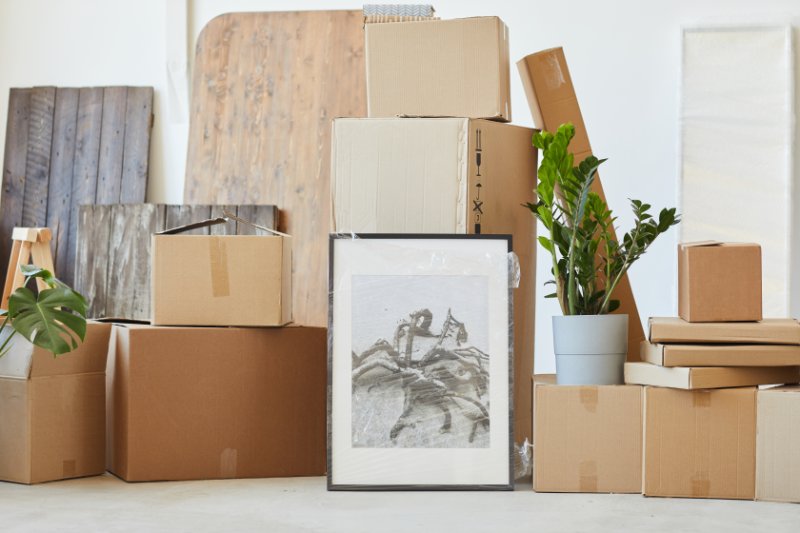
The right box is only part of the equation. These basics apply regardless of what size you’re using.
Wrap & Cushion Properly
Use packing paper or plain newsprint to wrap everyday items and prevent scratching. Crumple extra sheets to fill gaps; a half-empty box is a box waiting to collapse under the weight of the stack.
Seal with the H-Tape Method
The H-tape method helps distribute stress across the box and reduces the risk of the bottom opening when you lift it.
Start with the bottom of the box: tape the centre seam, then both side seams to form an “H” shape. Press firmly and repeat on the top after packing.
Seal Tops Before Loading
Even if you plan to add a few more items, seal the top before the box goes onto the truck. Unsealed boxes can spill, and an open top creates a collapse risk for anything stacked on top.
Label on the Side, Not the Top
When boxes are stacked, nobody can read the top. Write the destination room and a brief contents note on the side panel.
Mark the boxes with delicate items clearly using “FRAGILE”, and add “this side up” when it matters. Use a permanent marker so labels stay bold and easy to read.
For a more complete look at what to do before, during, and after your move, our guide to getting started with packing walks through the process room by room.
For moving appliances, the appliance packing guide covers disconnection, securing, and transport prep.
Can Cassidy’s Help with Boxes?
Yes. Cassidy’s Moving & Storage supplies moving boxes and packing materials for your move. Whether you need a few specialty boxes or enough supplies for a full home, getting your boxes through your mover keeps everything in one conversation.
If you would rather not pack at all, we also offer professional packing services. Our crew can pack your belongings using the right materials and techniques, which helps reduce the risk of damage and can save you time on moving day.
Ready to Move?
Getting the box right is not a small thing. The right moving box sizes protect your belongings, keep your crew safe, and make move day run more smoothly from start to finish.
Whether you’re moving across Ottawa or shipping overseas, the choices you make at the packing stage shape everything that comes after.
If you’re planning a move, request a residential moving quote from Cassidy’s Moving & Storage and ask us about the right boxes and packing supplies for your move. We’ll help you plan it properly, so moving day feels a little less stressful.
