

Table of Contents
If you’re shopping to buy or rent a shipping container, you’ve probably hit the same fork in the road as everyone else: standard or high cube?
The only physical difference between a high cube and standard container is one foot of height, but that one foot changes how much you can store, what you’ll pay, and how the container gets delivered.
We’ve been moving and storing belongings since 1908, so we’ve helped many Ottawa Valley families make this exact decision.

Free Ultimate Moving Checklist
Say goodbye to moving stress with our 2025 residential moving checklist for Canada—it’s the ultimate time-saver!
Download NowAnd it’s a choice more Canadians are making every year: the Port of Vancouver alone moved a record 3.8 million containers (20-foot-equivalents) in 2025, and many of those boxes eventually land in the very market that Canadians buy and rent from.
What Is a Standard Shipping Container?
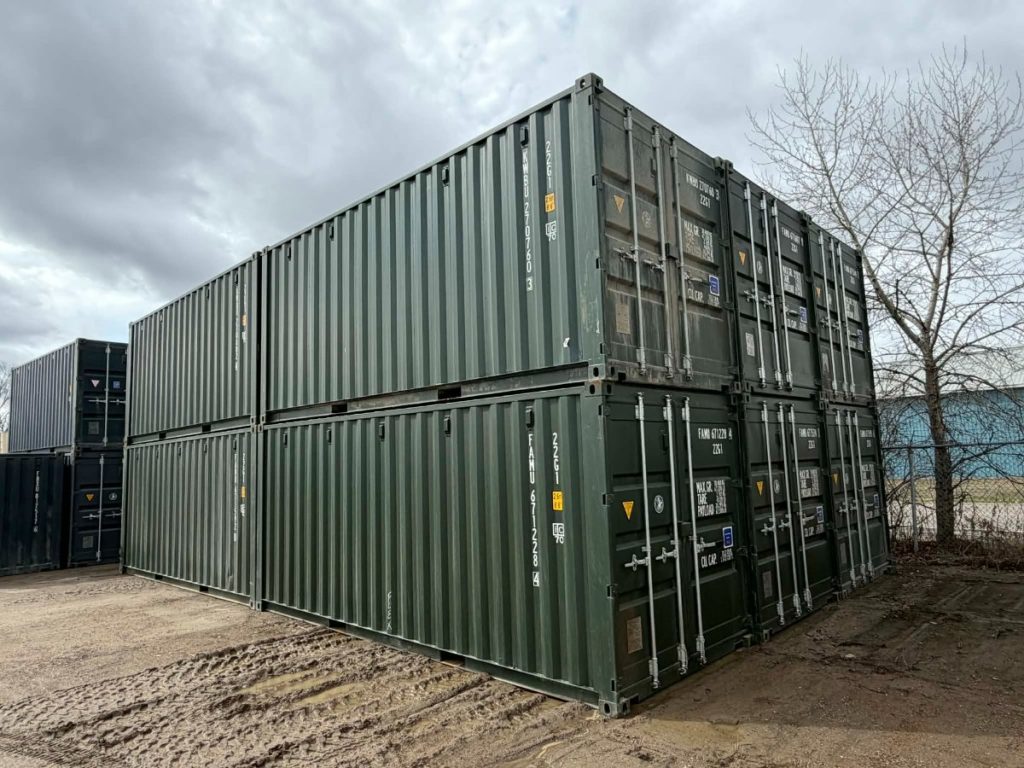
A standard shipping container, sometimes called a sea can, stands 8’6″ tall on the outside, with roughly 7’10” of interior headroom once you account for the floor and roof structure.
The 10-foot, 20-foot, and 40-foot lengths are the most common sizes, because they’re the easiest to find and the most affordable. For most household and business storage, a standard-sized shipping container is a great default choice.
What Is a High Cube Container?
A high cube container is the same shipping container with one change: the height measures 9’6″ on the outside instead of 8’6″, giving you roughly 8’10” of interior headroom and doors that open a foot taller.
Everything else, the width, the steel construction, the locking swing doors, is identical.
High cubes are built primarily in the 20-foot and 40-foot lengths. If you want the full measurements for every size, our guide to shipping container dimensions breaks them all down.
Side-by-Side Comparison Table
Here’s the whole comparison in one place, using the 40-foot size where the two are most often cross-shopped.
| Feature | Standard | High Cube |
| Exterior height | 8’6″ | 9’6″ |
| Interior height (approx.) | 7’10” | 8’10” |
| Width | 8′ | 8′ |
| Cubic capacity | 2,350 cu ft | 2,694 cu ft (about 15% more volume) |
| Empty weight | About 8,000 lbs | About 8,775 lbs |
| Availability by length | 10′, 20′, 40′ | 20’ and 40’ |
At Cassidy’s, we carry standard-height containers in all three lengths (10-foot, 20-foot, and 40-foot), and the high-cube version in the 20-foot and 40-foot lengths.
If you already know which one is best for your needs, request a shipping container quote, and we’ll confirm the delivery details with you.
When to Choose a High Cube
That extra foot earns its keep in a few specific situations:
- A full household move with tall furniture. Multiple tall items, such as wardrobes, bookshelves, and larger mattresses, can stand upright rather than lie flat. You can also stack boxes higher, and it’s easier to keep a walkway clear while you load.
- Tall or awkward cargo. Machinery, stacked pallets, canoes on end, or anything that brushes the ceiling of a standard box.
- Shelving and forklift work. If you’re racking the interior or loading with equipment, the taller door opening and ceiling give you working clearance that a standard can’t.
- Conversions. Tiny homes, site offices, and workshops all lose vertical space if insulation, wiring, and ceiling finishes are added. Start with a high-cube, and you end up with a comfortable room without needing to duck.
- Long-term storage where volume matters. An extra 344 cubic feet is roughly the contents of another bedroom. If you’re storing a full household or a business’s worth of inventory, that space can be the difference between one container and two.
Pro tip: The container’s door opening is a few inches shorter than its interior height, so if a piece is taller than the door opening, you’ll have to angle or tip it in as it comes through the doorway, then stand it upright once it’s inside. Measure your tallest item before you order so you know which pieces need the manoeuvre.
When to Choose a Standard Container

For most people, the standard is still the right call:
- Budget-first buyers. Standards cost less to buy or rent, and the used supply is deeper, so you have more choice. Our guide to the cost of shipping containers walks through what to expect.
- Sites with overhead clearance limits. Tree branches, overhead wires, carports, and low outbuildings can all rule out the taller box, both where it sits and along the delivery path.
- For lower heating/cooling costs. If you’re climate-controlling the container, less interior volume means lower heating and cooling costs.
- Everyday storage. Furniture, seasonal gear, tools, business records: if nothing you’re storing needs more than 7’10” of headroom, the extra room is money wasted.
What Canadian Buyers Should Consider
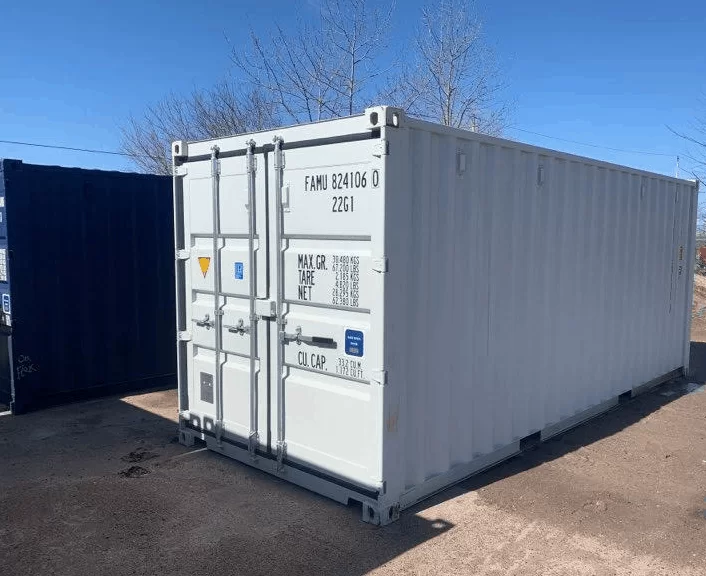
Most container guides are written for buyers in warmer climates. Buying in Ottawa or the Upper Ottawa Valley comes with a few wrinkles of its own.
Winter & Rural Delivery
A shipping container arrives on a tilt-bed truck that needs room to tip the box off, which takes more overhead and lane clearance than the container alone.
Snowbanks narrow laneways, and low branches that were no problem in the summer are ice-loaded in the winter.
On rural properties around Pembroke, Renfrew, or Arnprior, a long laneway or a soft spring approach can matter as much as the area the container sits on. We deliver year-round, and we’ll talk through your site before the truck arrives, so there are no surprises on delivery day.
Supply & Pricing Move with Demand
Used containers come out of the freight system, so what you pay tracks how busy that system is.
Statistics Canada reported 36.5 million tonnes of freight moved by intermodal containers on Canadian rail in 2022, and when these volumes shift, the supply of retired boxes follows.
It’s why quotes are worth getting fresh rather than trusting last year’s prices.
Buying vs Renting
If the container is for a move, a renovation, or seasonal storage, renting usually wins: you pay for the months you need, and the container is removed when you’re done.
If it’s staying on your property for years as a workshop, farm storage, or a future conversion, buying makes more sense.
Either way: if you’re shopping for used containers online, buy from a company you can visit, so you avoid the common scams, especially listings that want full payment before you’ve seen the unit.
Get the Right Container the First Time
The high cube vs standard container decision comes down to a simple question: does anything you’re storing, building, or loading need more than 7’10” of headroom? If yes, the high cube pays for itself. If not, the standard saves you money.
After moving and storing what matters to Ottawa Valley families and businesses since 1908, we’re happy to help you make the right decision for your needs.
Request a shipping container quote or call us at 613-836-4225, and you’ll talk sizing with a real person who’s placed containers on driveways from Barrhaven to Pembroke.
